
Activity case study
LED Planck: virtual laboratory
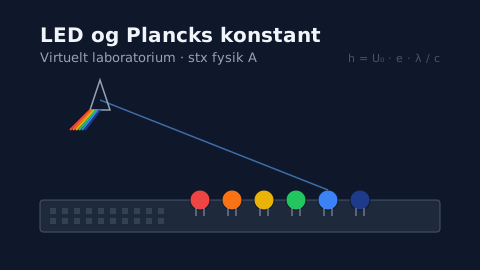
LED Planck explores a procedural activity based on a Danish upper-secondary experiment for estimating Planck's constant using light-emitting diodes.
Unlike a phenomenon simulation built mainly around sliders and graphs, a procedural virtual laboratory represents equipment, sequence, measurement, and analysis. The activity is used to investigate how AI might support experimental preparation and interpretation without pretending to replace a real laboratory.
Experimental idea
In the physical experiment, students examine the relationship between an LED's threshold voltage and the energy associated with emitted light. With wavelength information and appropriate modelling assumptions, measurements can be used to estimate Planck's constant.
The activity draws attention to several linked forms of reasoning:
- assembling and understanding the circuit;
- identifying what should be measured;
- relating colour or wavelength to photon energy;
- deciding how threshold voltage is determined;
- organising measurements across several LEDs;
- plotting or fitting an appropriate relationship; and
- interpreting the result and its uncertainty.
What the virtual lab represents
The interactive artefact provides a simplified laboratory sequence with equipment and measurement steps. Students work through setup, observation, data collection, and calculation rather than receiving a completed dataset immediately.
The virtual representation can help students become familiar with the logic of a procedure before or after working with physical equipment. It cannot reproduce equipment handling, component variation, imperfect contacts, ambient light, calibration, or the many practical judgements involved in a real experiment.
Possible roles for the tutor
A paired tutor can ask students to:
- explain why a component is included;
- predict the effect of changing a quantity;
- identify an implausible measurement;
- distinguish observation from inference;
- select axes and interpret a graph;
- discuss assumptions behind the calculation; or
- compare the virtual procedure with their physical experiment.
It should not silently complete the calculation or present simulated values as if they were classroom measurements.
Research questions raised by the activity
The case study makes several questions concrete:
- Does virtual rehearsal improve students' preparation for physical laboratory work?
- When does troubleshooting support reasoning, and when does it remove productive difficulty?
- How should an AI system communicate uncertainty about experimental data?
- Can the tutor help connect a procedural step with the physical model behind it?
- How do students distinguish data generated by a simulation from data measured in the laboratory?
Migration into AIPLA
The original generated artefact demonstrated the procedural form. In AIPLA it is delivered through the reviewed artefact environment and paired with centrally configured tutor behaviour. Students do not supply an AI service key in the browser.
The maintained case study focuses on the educational design and its limitations. Detailed integration specifications and internal prompts remain engineering and research material rather than public student instructions.
- Content status
- Current
- Maintained by
- AIPLA project team
- Last reviewed