
Activity case study
Boldkast: projectile motion
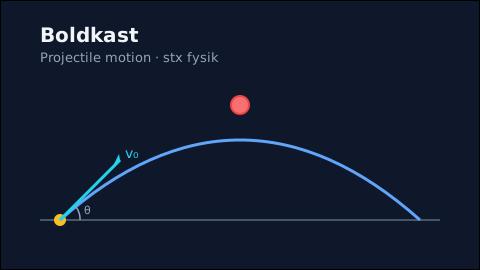
Boldkast was the first complete AIPLA activity to connect a guided physics tutor with an interactive workbench. It is based on a Danish upper-secondary projectile-motion problem and asks students to coordinate a physical situation, equations, trajectory, velocity components, and a simulation.
What students work with
The workbench includes the problem statement, a projectile-motion simulation, and a progress checklist. In the simulation, students can vary quantities such as initial speed, launch angle, and gravitational acceleration, then inspect the resulting trajectory and calculated values.
On larger screens, conversation and workbench can be visible together. On phones, the same two surfaces are available through a compact tabbed layout.
The tutor's role
The tutor is configured to scaffold rather than solve. It can ask for a prediction, direct attention to a representation, invite the student to compare two runs, or ask the group to explain a relationship.
The activity uses three broad phases:
- Prediction: commit to an expectation before running the simulation.
- Observation: inspect the trajectory, graph, or values after changing a condition.
- Reflection: articulate what changed, what remained constant, and why.
The tutor should remain concise, respond to the students' current stage, and avoid turning every exchange into a lecture.
Connecting workbench and conversation
When a student changes a relevant value or completes a workbench action, the platform can share that structured state with the tutor. A visible card tells students what was shared.
This creates a bidirectional loop:
- the student changes a value;
- the workbench records the interaction;
- the tutor receives the relevant state;
- the tutor's next question can use the actual value or observation; and
- the student returns to the workbench to test the next idea.
The visibility of that loop matters. Students should not have to guess whether the tutor can see their work, and the tutor should not claim access to information it has not received.
Physics learning opportunities
Boldkast can support discussion of:
- independent horizontal and vertical motion;
- how gravitational acceleration affects vertical velocity;
- the relationship between launch conditions and range;
- the difference between a trajectory and velocity graphs;
- the assumptions built into an idealised projectile model; and
- how simulation evidence relates to an analytical calculation.
The simulation does not establish those ideas by itself. Learning depends on the predictions, comparisons, explanations, and teacher framing around it.
Try the workbench
The embedded demonstration below is the maintained Boldkast artefact used by the application. It runs here without a tutor or class session so visitors can inspect the interactive half of the activity directly.
Try the Boldkast workbenchChange the launch conditions and compare trajectories.Loading…This public demonstration shows the workbench by itself. In a class activity, its relevant actions can also be shared visibly with the tutor.
What the case study established
Boldkast demonstrated the reusable activity structure that later examples build on: teacher-prepared context, a reviewed interactive artefact, a tutor with activity-specific instructions, structured sharing between surfaces, and group-based access.
It also highlighted design questions that remain relevant: how directive the tutor should be, how much workbench state to share, how to support a shared phone, and how teachers inspect a group's session afterward.
Open the group join page to use a code provided by a teacher.
- Content status
- Current
- Maintained by
- AIPLA project team
- Last reviewed